

How to Use a Voice Changer in Steam Games (Step-by-Step Guide)
2026-03-12 16:30:28

Create Unique Gaming Voices for Steam & Discord – Tips for Engaging Voice Changers
2026-03-06 15:13:55
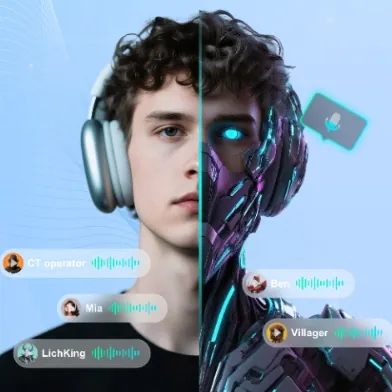
Enhance Twitch & YouTube Streams with Multi-Character Voice Acting – VoxMagic
2026-02-26 15:53:54
AI Voice Changer vs Text-to-Speech: STS vs TTS Explained for Creators & Gamers
2026-01-30 10:34:54

Real-Time Voice Gender Change on PC | AI Voice Changer for Gaming & Streaming
2025-12-12 10:27:28
AI Voice Changer vs Text-to-Speech: STS vs TTS Explained for Creators & Gamers
2026-01-30 10:34:54
AI Voice Changer vs Text-to-Speech: What’s the Real Difference Between STS and TTS?
1. Introduction
AI voice technology has rapidly entered the mainstream. Terms like Text-to-Speech (TTS), Voice Cloning, and AI Voice Changers appear across gaming, content creation, and film, yet they are often used interchangeably.
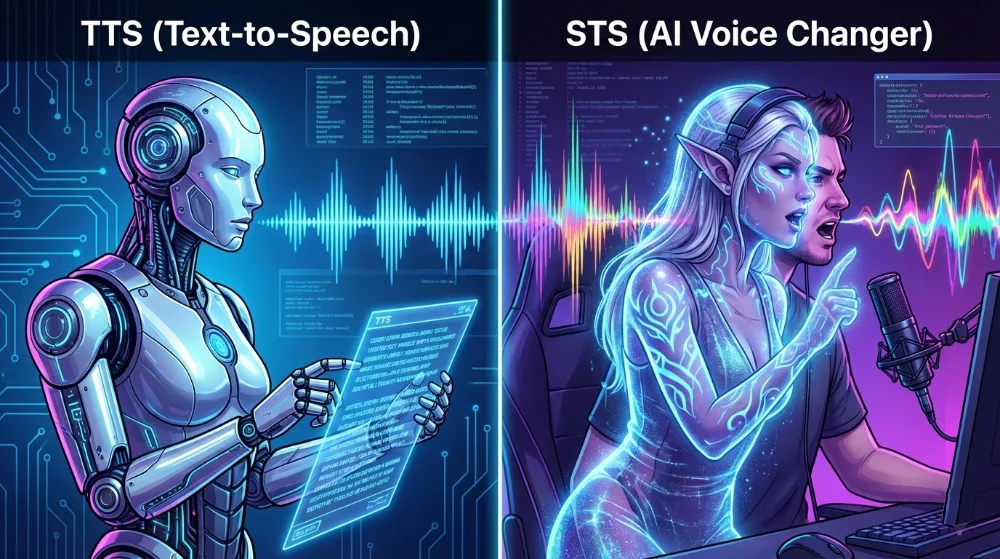
While all generate speech, the difference lies in how the voice is created. TTS acts like a reading machine, producing speech from text, whereas AI Voice Changers or Speech-to-Speech (STS) systems work like a digital skin, transforming human performances while keeping timing, emotion, and expression intact.
Whether you are a content creator or a gamer, choosing the right tool is key. Here is how they compare.
2. Speech Synthesis & TTS — The AI "Reader"
Text-to-Speech (TTS) is the core of AI speech synthesis. It converts text into natural-sounding audio, allowing AI to “read aloud” written content. Early TTS systems produced mechanical, robotic voices, but modern Neural TTS leverages deep learning to generate speech that is far more natural, expressive, and human-like.
From an engineering perspective, TTS systems are built on acoustic models and neural vocoders that map text tokens into mel-spectrograms and then synthesize waveform audio.
Voice Cloning adds identity, enabling TTS to sound like a specific speaker by capturing tone, pitch, and style. The difference between synthetic and cloned voices lies in identity preservation — TTS provides content, cloning provides personality.
Typical use cases for TTS and Voice Cloning include:
- Generating large-scale content, such as audiobooks, news articles, or educational materials.
- Producing speech without needing a human voice recording, saving time and resources.
- Creating personalized voice experiences for apps, virtual assistants, or accessibility tools.
Essentially, if you have a script but no actor, TTS is your solution.
3. AI Voice Changers & STS — AI’s “Voice Actor”
Speech-to-Speech (STS), commonly known as AI Voice Changers, transforms an existing voice into a new one while preserving the original performance. Unlike TTS, which starts from text, STS takes audio input and modifies timbre, pitch, or style, giving a performance a new voice identity.
What sets STS apart is its ability to retain emotion, timing, and expression, not just pitch or tone. As Respeecher highlights, STS retains the subtle timing, laughter, or whispers that a machine reading text simply cannot guess.
Tools like VoxMagic AI Voice Changer illustrate this power. They allow gamers and streamers to adopt completely new vocal identities—like a fantasy character or a celebrity—while their real laughter and excitement shine through naturally.
(Optional: Check out our guide on [how to use VoxMagic for Discord] to see this in action.)
4. Core Comparison: Text-to-Speech vs. Speech-to-Speech
The key difference between TTS and STS isn’t quality — it’s where the performance comes from.
| Dimension | TTS / Voice Cloning | STS / AI Voice Changers |
|---|---|---|
| Input Source | Text (requires written content) | Audio (requires existing voice performance) |
| Control | High over content, limited emotional nuance | High preservation of original emotion, timing, and performance |
| Creation Difficulty | Low — minimal recording needed; scalable | Medium — needs source audio and processing, but retains complex performance |
| Best Use Cases | Audiobooks, news, educational content, personalized virtual | Games, films, streaming, interactive media, character |
Rule of thumb:
- If your workflow starts from a script → choose TTS.
- If your workflow starts from a human voice → choose STS.
Key Takeaway: Use TTS for automation; use STS for expression.
5. Ethics & Future
With great power comes great responsibility. Misusing voice cloning for scams or deepfakes is a serious industry concern.
To combat this, ethical AI developers prioritize Consent and Watermarking.
- Consent: Ensuring the original voice owner agrees to the cloning.
- Watermarking: Embedding invisible signals to identify AI-generated audio.
Future tools will become even more realistic. For creators, using transparent and authorized tools is essential to stay on the right side of the law.
6. Conclusion
Your choice between TTS and STS depends entirely on your workflow.
Need to turn a 50-page PDF into an audiobook? Go with TTS.
Want to roleplay a goblin in your next D&D session or dub a video? Grab an AI Voice Changer like VoxMagic.
Understanding this distinction ensures you don’t just get a voice, but the right voice for your story.


 Fionn
FionnCopyright © 2026 Wonderful Apps Limited.
 English